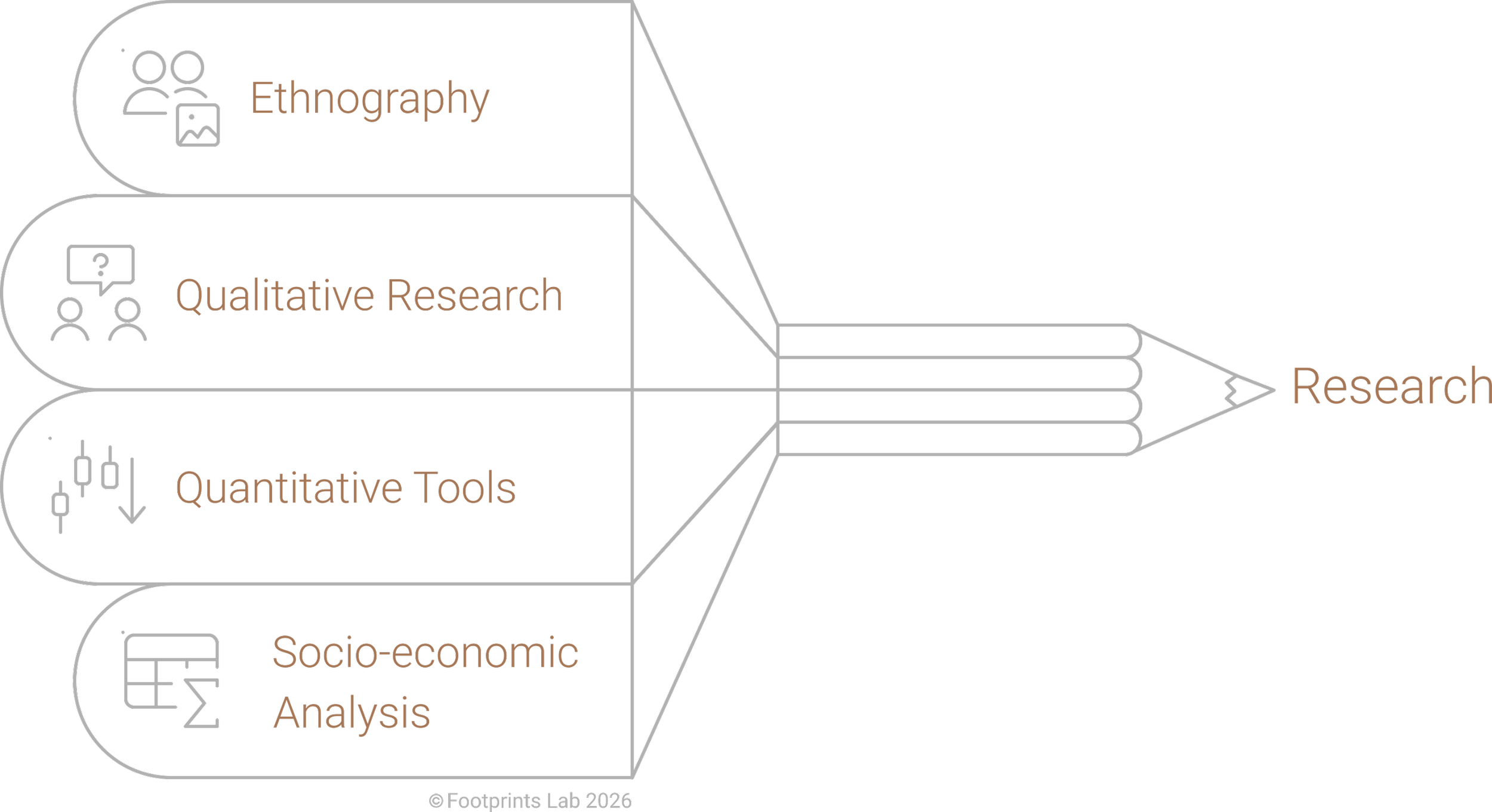
Our Research Manifesto
guides us to understand how territories function as social, economic, and relational systems — combining fieldwork, data, and stakeholder insight.
Our Principles
In order to generate meaningful insights beyond the surface, we believe that:
-
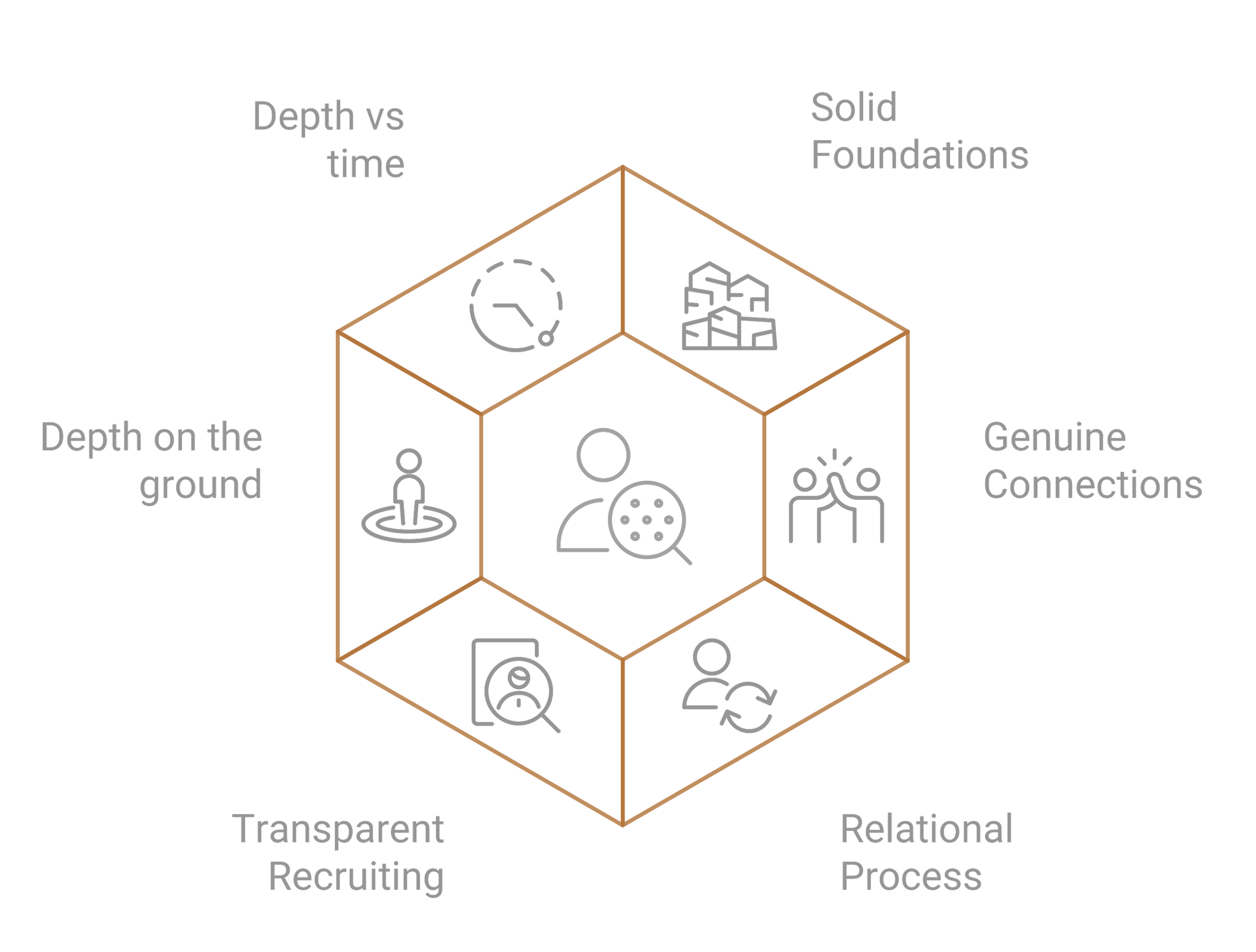
Community studies have to be built on robust methodological foundations that aim at depth, clarity and relevance for territorial context.
-
Engagement with community is based on honest connections, beyond fast, extractive data collection and preconceived assumptions or external biases.
-
Our research approach is never linear or extractive: arrive⭢ ask⭢ record⭢ leave.
By engaging with communities as organic social systems rather than data sources, we capture complexity without simplifying lived experiences. -
Transparent and thoughtful participant recruitment is a core research activity. Engaging the right voices in the right way strengthens the effectiveness of insights and their capacity to support meaningful, context-aware outcomes.
-
In-depth research relies on direct presence within territories.
On-site interaction allows to grasp social dynamics, informal processes, and contextual nuances that cannot be fully accessed remotely. -
Meaningful insights do not depend on the length of fieldwork alone.
With appropriate methods and careful design, it is possible to go deep even within limited timeframes — provided research remains focused, grounded, and methodologically sound.
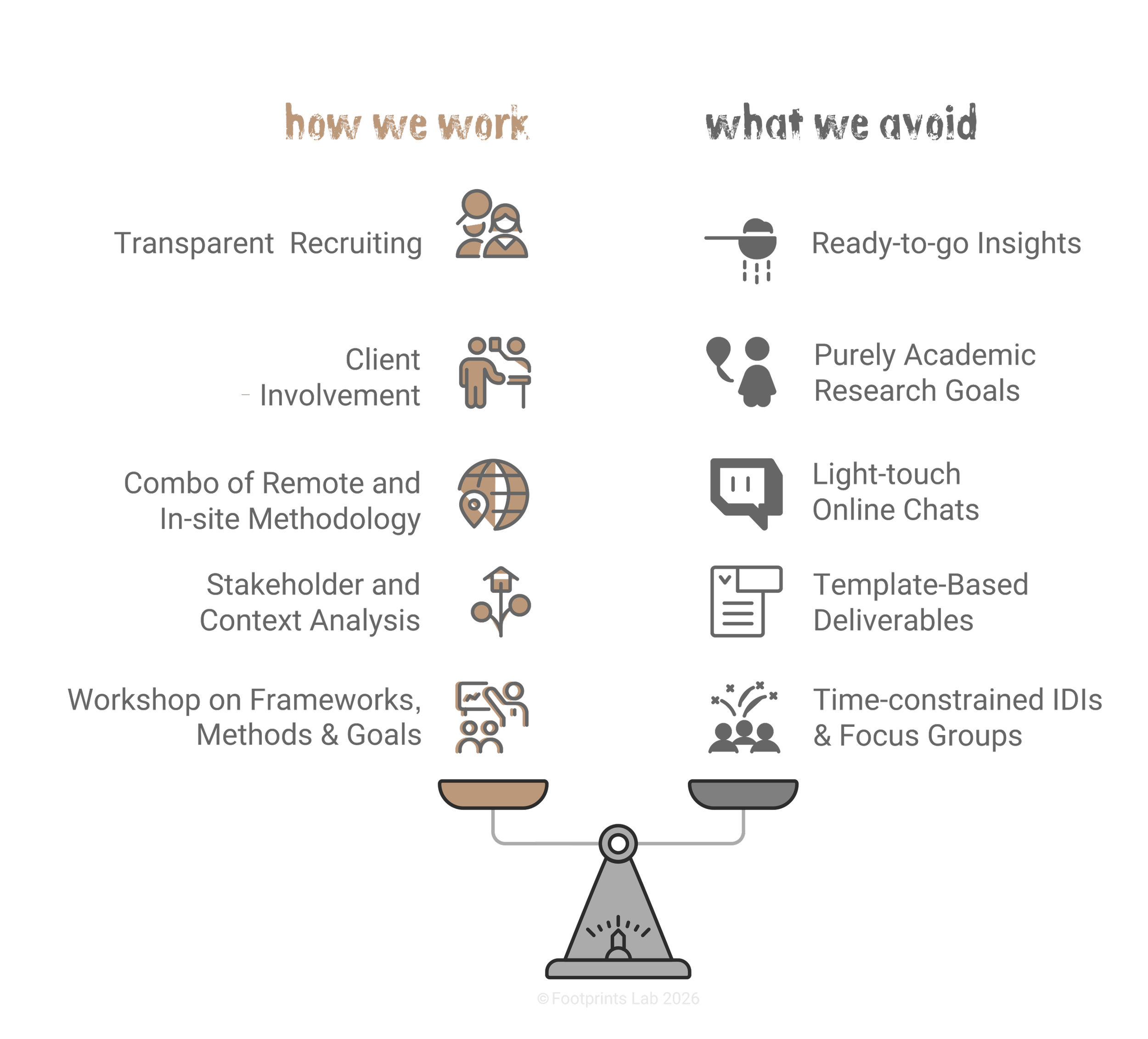
Our Lessons Learned
Despite the inherent limits of actual fieldwork, we build on experience to propose research approaches that balance rigor and effectiveness.
Our Toolbox
A mixed approach integrates and combines multiple tools - both quant & qual - with rigor to generate robust, context-aware insights, and represents the added value of our methodology.
-
Contextual Immersions and Participant Obseravtuon involve researchers spending extended time within the community setting, observing daily practices, interactions, and routines in their natural context to gain deep, firsthand understanding of lived experiences.
Ethnography can tacit knowledge, unspoken norms, and behavioral patterns that community members might not articulate in interviews, providing rich insights into the actual rather than reported reality of community life.
-
A Focus Group (FG) brings together small groups of community members to discuss specific topics, allowing participants to share perspectives, build on each other's ideas, and generate collective insights through moderated dialogue.
A FG enables participation of different community members while capturing the dynamic interplay of diverse viewpoints, revealing how consensus forms and disagreements emerge within the community.
-
An IDI - In-depth Interview - involves one-on-one conversations between a researcher and a community member, using open-ended questions to explore individual experiences, motivations, needs, and perspectives in detail.
It creates a safe, confidential space where participants can share sensitive information, personal narratives, and nuanced viewpoints they might not express in group settings, uncovering the depth and complexity of individual lived experiences.
-
This method involves researchers accompanying community members as they move through their everyday environments and routines, engaging in conversation while observing how people interact with and navigate their physical and social spaces.
It captures the embodied, situated nature of community life by revealing how meaning is created through movement and place, uncovering spatial practices, territorial boundaries, and environmental relationships that emerge only through direct experience of the locality.
-
These method are used to systematically collect standardized information from a large number of community members through structured questions, enabling quantification of opinions, behaviors, needs, and demographic characteristics across the population.
They provide statistically representative data that reveals the prevalence and distribution of specific needs within the community, allowing researchers to identify priority areas, compare subgroups, and establish baseline measures that can inform evidence-based interventions and resource allocation.
-
Digital ethnography applies the principles of traditional fieldwork to online environments. Rather than observing a community in a physical territory, the researcher immerses in the digital spaces where people talk, debate, and form opinions — forums, social media platforms, comment sections, community groups, and sector-specific networks.
The method goes beyond data extraction. It involves sustained observation over time: tracking how conversations evolve, identifying who the informal opinion leaders are, and mapping the narratives that communities build around a given topic.
The goal is not to count mentions or classify sentiment, but to understand the underlying dynamics — what people actually mean, what they fear, what they expect, and what they leave unsaid.
This is what distinguishes digital ethnography from standard social listening or sentiment analysis. Those tools tell you what is being said. Digital ethnography tells you why, and what it reveals about a community's values, concerns, and social fabric.
-
This method asks previously selected community members to document their daily experiences, activities, and reflections over time using smartphones or digital platforms, capturing photos, videos, audio recordings, or written entries in real-time as events unfold.
A digital diary reveals evolving needs and contextual challenges as they occur in participants' natural environments, reducing recall bias and providing authentic, longitudinal insights into how community members experience and prioritize their needs throughout different moments and situations in their everyday lives.
-
This method involves conducting structured conversations with individuals who hold formal or informal leadership roles within the community, such as local officials, media experts, activists, or long-standing residents with deep community knowledge.
An Expert Interview provides strategic perspectives on community-wide needs and systemic issues, as leaders often possess historical context, understanding of power dynamics, and awareness of underserved populations that can help researchers identify both visible and hidden priorities while facilitating access to harder-to-reach community members.